What is a Molded Case Circuit Breaker (MCCB)?
A Molded Case Circuit Breaker (MCCB) is a heavy-duty, automatic electrical protection device designed to safeguard industrial and large commercial power systems from severe overloads and short circuits. Unlike standard MCBs, MCCBs feature significantly higher current ratings (up to 2500A), adjustable trip settings, and robust arc-extinguishing capabilities.
For M&E engineers and contractors, especially in Singapore and Malaysia, selecting an MCCB that complies with IEC 60947-2 is mandatory for securing EMA or Suruhanjaya Tenaga (ST) project approvals. In this guide, BTB Electric details the structural components, technical specifications, and key considerations for specifying the right MCCB for your next heavy-duty installation.
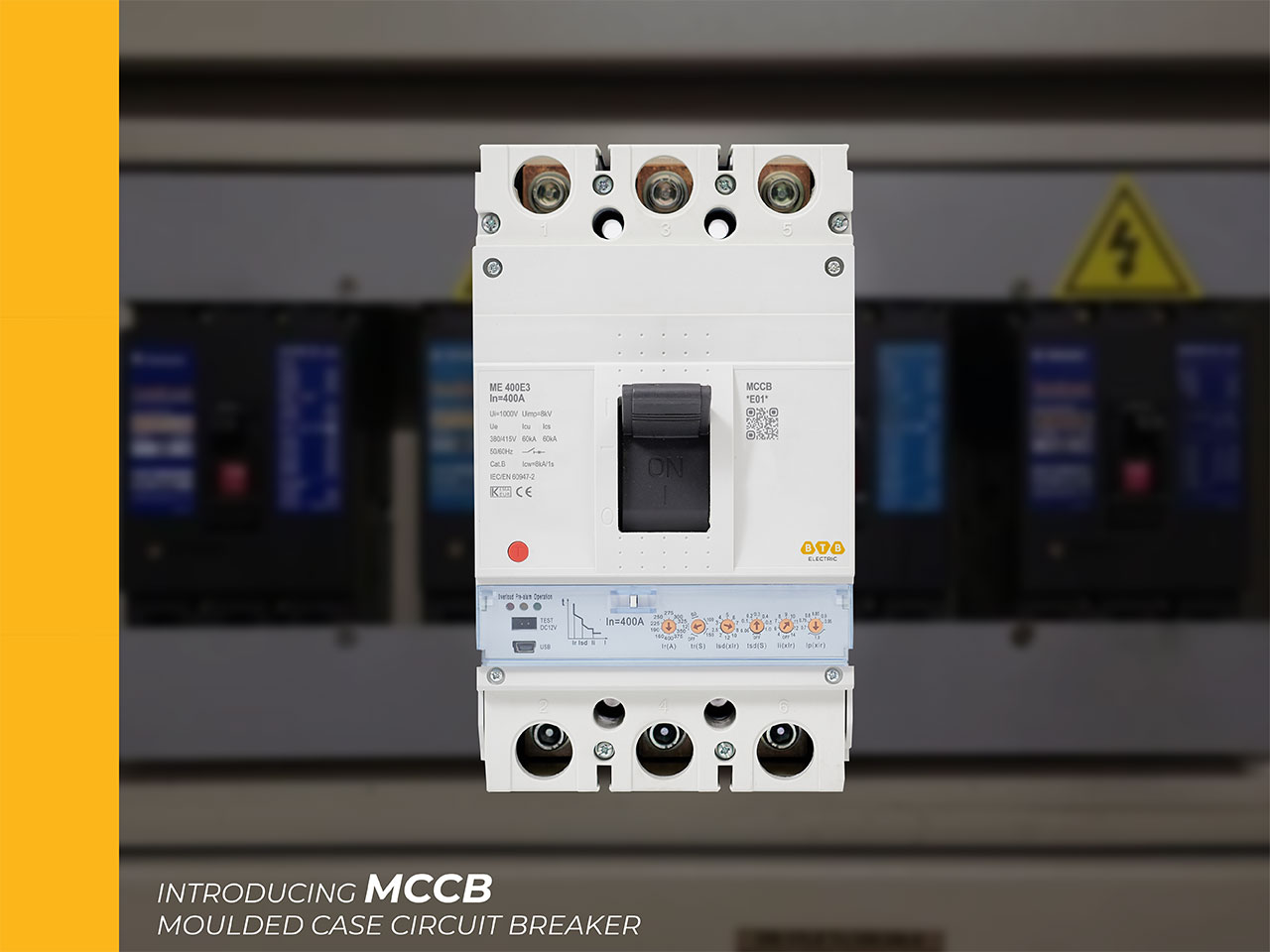
MCCB has three main functions:
- Protecting circuits against overload – when the rated current is abnormally high, preventing the line from heating up. MCCB uses a bimetallic strip or heating element in the breaker to heat up when an overload current flows through it, bending and causing the circuit to trip.
- Protecting the circuit when there is a short circuit, helping to avoid damage to the electrical system. MCCB uses a magnetic trip unit, interacting with the magnetic field generated by the short circuit current to cut off the power.
- Controlling the electrical circuit with the on-off mechanism is very important when the electrical system needs to be checked, maintained, repaired or upgraded.
Structure
Molded Case Circuit Breaker has a traditional circuit breaker structure, mainly consisting of the following parts:
- Frame: The outer shell of the MCCB, made of high-quality plastic, sturdy, durable, with good insulation and heat insulation.
- Operating handle: Used to turn the device on or off, holding the handle in the correct position when switched on. If there is a fault, this mechanism will automatically turn off and the MCCB will have to be switched on or off manually.
- Trip unit: MCCB trips when overload or short circuit is detected.
- Lever: Used for MCCB maintenance, the technician will use the lever to manually turn the device on and off.
- Terminals: Contact point for wires, ensuring tight connection.
- Arc chute: Used to separate the arc into small pieces when the MCCB breaks the normally closed contact and creates an arc.
- Push-to-trip button: Added to MCCB to perform tripping when required.
- Contacts: The core making and breaking components, consisting of fixed contacts and moving contacts.
Technical parameters
Some important parameters on Molded Case Circuit Breaker you need to know are Ui, Ue, Uimp, In, Icu and Ics. Specifically, the roles of these parameters are as follows:
- Ui – Rated insulation voltage (V): The maximum voltage that the MCCB’s internal insulation can withstand under laboratory conditions.
- Ue – Rated working voltage (V): The continuous operating voltage of the MCCB, which aligns with the system voltage (e.g., 400V, 690V).
- Uimp – Rated impulse withstand voltage (kV): The peak impulse voltage the breaker can withstand during transient events, such as lightning strikes or switching surges.
- In – Rated current (A): The maximum continuous current the MCCB can carry under normal operating conditions without tripping.
- Icu – Ultimate short-circuit breaking capacity (kA): The absolute maximum fault current the MCCB can safely interrupt. After interrupting an Icu level fault, the breaker may not be usable and must be inspected or replaced.
- Ics – Service short-circuit breaking capacity (kA or % of Icu): The maximum fault current the MCCB can interrupt safely while remaining fully operational for continued use. A higher Ics indicates a more robust and durable MCCB.
Operating principle
Most Molded Case Circuit Breakers operate on a thermal-magnetic mechanism to detect faults and disconnect the power.
- Thermal protection (for overloads): Utilizes a bimetallic contact that expands as temperature changes. When an overcurrent occurs, the contact heats up and bends to break the circuit. This mechanism intentionally incorporates a time delay to allow for short-term, normal overcurrents (such as motor inrush currents) without causing nuisance tripping. However, sustained overloads will trigger the disconnect to protect equipment.
- Magnetic protection (for short circuits): Relies on electromagnetic induction for instantaneous response. When a massive fault current flows through, it creates a strong magnetic field in the internal solenoid coil, instantly breaking the contact. MCCBs also feature integrated arc chutes to safely dissipate the electrical arcs generated during these rapid interruptions.
Classification
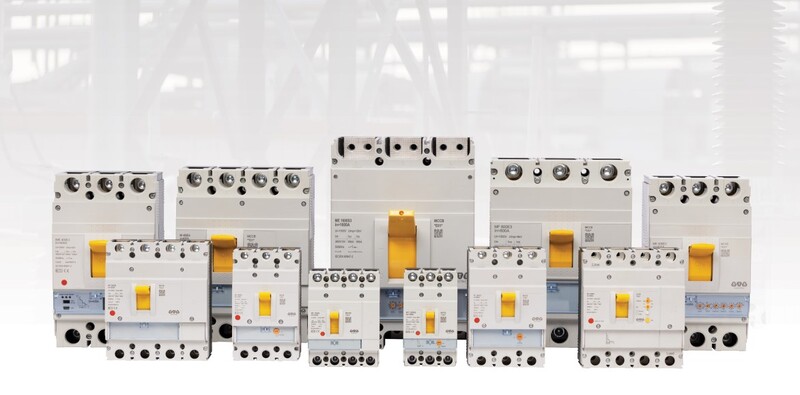
Molded Case Circuit Breakers from BTB Electric is of high quality, meeting IEC 60947-2 standards with 4 codes:
- MF MCCB: Fixed circuit breaker – protection relay T01; rated current range (In) from 20A to 800A; short circuit breaking current at (Ue) = 690V is 25kA, 36kA, 50kA and 85kA.
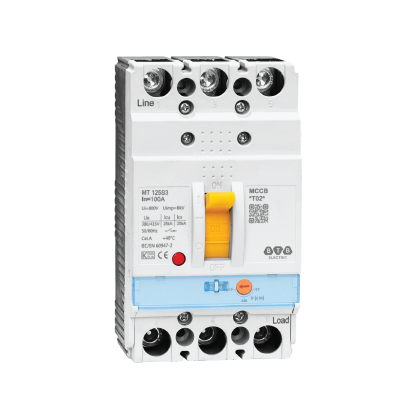
- MT MCCB: Thermal control mechanism circuit breaker – protection relay T02; rated current range (In) from 20A to 800A; short circuit breaking current at (Ue) = 690V is 18kA, 25kA, 36kA, 50kA and 60kA.
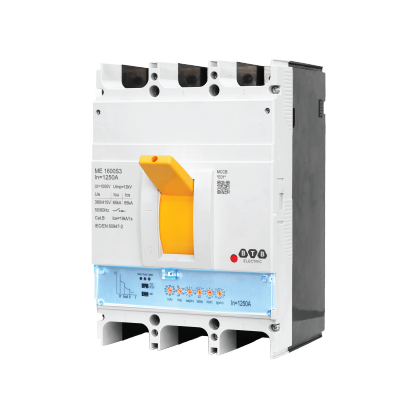
- ME MCCB: Electronic mechanism circuit breaker – protection relay E01; rated current range (In) from 320A to 1600A; short circuit breaking current at (Ue) = 690V is 60kA and 65kA.
- iME MCCB: Electronic mechanism circuit breaker – protection relay E01 – remote control; rated current range (In) from 320A to 800A; short circuit breaking current at (Ue) = 690V is 60kA and 75kA.
Outstanding features of MCCBs from BTB Electric:
- High efficiency and class A selectivity
- Made from environmentally friendly ingredients, all recyclable.
- Designed for safety in all situations
- Current frame from 125A to 1000A
- Applicable standards: IEC/EN 60947-2
- Quality certificate: DEKRA
For details on specifications, product catalogues, drawings and certificates, please refer to the MCCB BTB Electric product page.
In addition, Molded Case Circuit Breakers can be classified according to their operating range, denoted as B, C, D, K, Z respectively. Specifically, the differences between these types are as follows:
| Trip curve |
Tripping current (Multiple of In) |
Tripping time |
Primary load type |
Typical industrial applications |
| Type B |
3 - 5x In |
0.04 to 13 seconds |
Resistive loads |
Large-scale lighting, heating elements, long cable runs |
| Type C |
5 - 10x In |
0.04 to 5 seconds |
Moderate inductive loads |
Small industrial motors, commercial transformers, control circuits |
| Type D |
10 - 20x In |
0.04 to 3 seconds |
Heavy inductive/capacitive loads |
Heavy machinery, large transformers, lifting hoists, welding machines |
| Type K |
8 - 12x In |
0.04 to 5 seconds |
High inrush current loads |
Heavy-duty industrial motors, X-ray machines |
| Type Z |
2 - 3x In |
0.04 to 5 seconds |
Highly sensitive equipment |
Semiconductor testing facilities, IT data centers, medical devices |
MCCB is a mandatory element for industrial and commercial electrical systems to operate smoothly and ensure system safety.
Applications
Molded Case Circuit Breaker is mainly used in industrial electrical systems. Thanks to its design and many superior features compared to conventional circuit breakers, this line of circuit breakers is very suitable for specific applications in industrial electricity with high safety and precise operation.
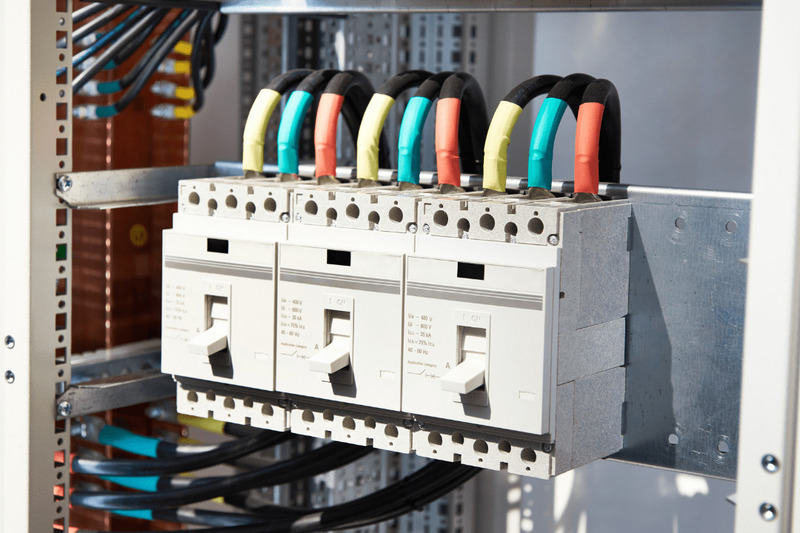
Specifically, some key applications of MCCBs include:
- Main power supply protection: Power circuits supplying large distribution boards often carry hundreds of amperes. MCCBs are required to handle these heavy loads and allow for future interrupt adjustments if more circuits are added.
- Motor protection: Industrial electric motors generate massive inrush currents upon startup. MCCBs with specific trip curves (like Type K or D) can be finely adjusted to provide overload protection without nuisance tripping during engine startups.
- Capacitor bank protection: Essential for power factor correction in commercial grids. Large capacitors draw high currents and require robust MCCB protection to reduce input currents and stabilize electrical costs.
- Generator protection: Large gensets provide hundreds of amps of output and risk grid conflicts. The high current rating and heavy-duty frame of MCCBs provide reliable protection for these expensive assets.
- Welding applications: Industrial welding machines draw erratic and extremely high currents that exceed the capabilities of standard MCBs, necessitating the use of MCCBs.
- Low-current adjustable applications: MCCBs are not exclusively for high-current scenarios. Models rated under 125A are often used when low-power critical equipment requires an adjustable trip setting, a feature unavailable in standard DIN-rail MCBs."
Key differences between MCCB and MCB
Looking from the external design, it can be seen that MCCB is “more massive” than MCB. Correspondingly, the parameters on the high-capacity circuit breaker line are superior to those of the small circuit breaker.
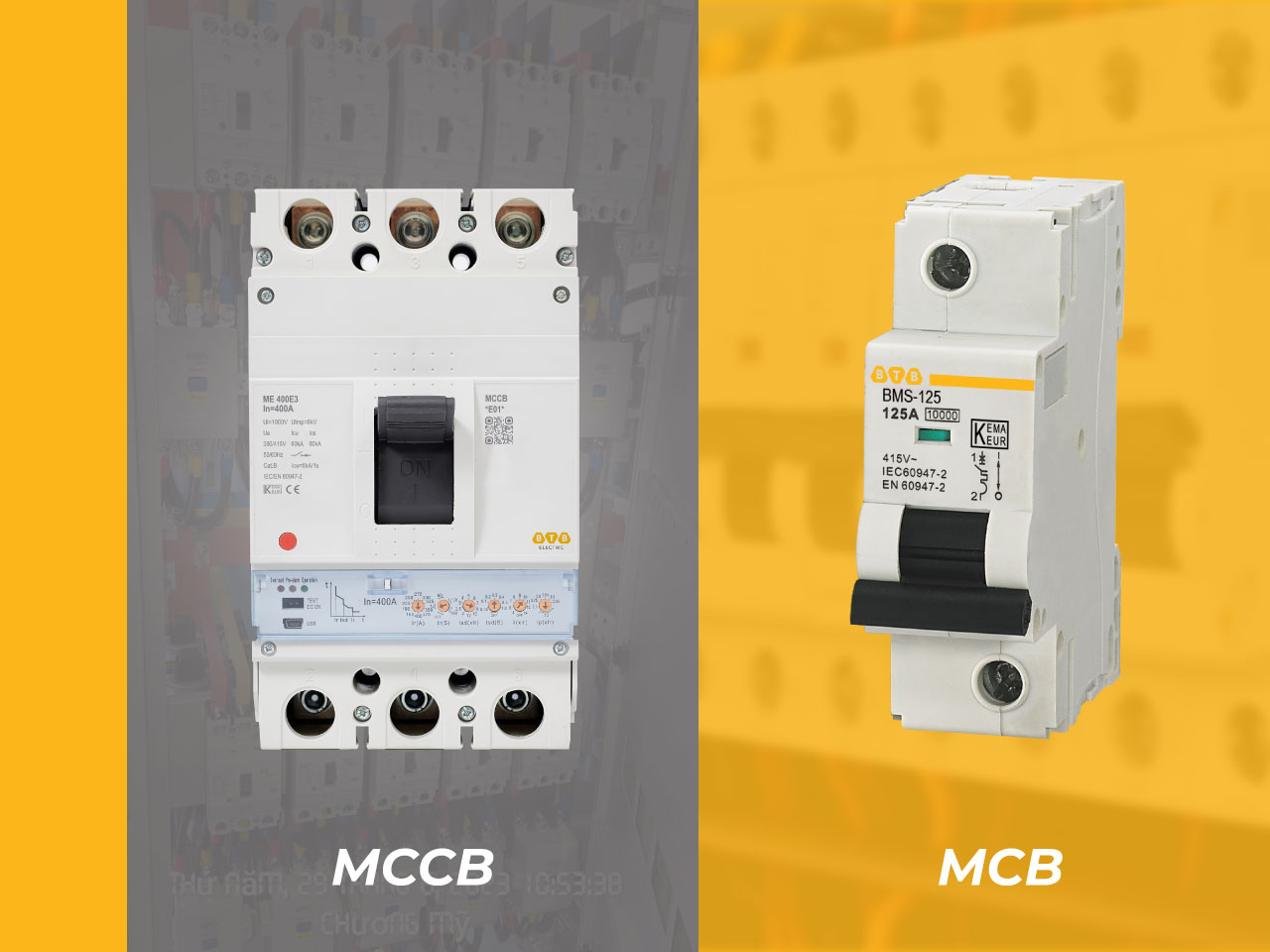
Molded Case Circuit Breaker is mainly used for industrial electrical systems (3-phase electricity), for devices with high power current, current reaching 2500A or some special cases. Miniature Circuit Breaker is widely used in household electrical networks and low-power electrical devices, maximum current about 125A.
Notes when choosing to install MCCB
The basic principle when selecting MCCB is the formula IB < In < IZ, in which:
- IB: maximum load current
- In: rated current of MCCB
- IZ: maximum allowable current through the conductor
Note that in practice, In is usually 25 – 30% higher than IB to prevent the risk of sudden voltage increase in case of a problem.
In addition, engineers must ensure the breaking capacity satisfies the condition Icu ≥ Isc (where Icu is the ultimate breaking capacity of the MCCB and Isc is the prospective short-circuit current at the installation point).
In addition, when choosing a MCCB, you need to pay attention to the compatibility of the device with the electrical system with the option of having or not having a neutral wire. If there is a need to periodically maintain and upgrade the electrical system, the remote control feature of the MCCB is very important and should be equipped.
FAQs
Question 1: Can MCCB be used for household electricity?
Answer: MCCB is mostly used for 3-phase 380V electricity. Some 1-phase 2-pole MCCB models can be used for household electricity, but the cost will be higher if using MCB with equivalent technical specifications.
Question 2: Does MCCB have leakage protection?
Answer: MCCB does not have the function of preventing leakage current or electric shock. MCCB only has the function of preventing overload and short circuit.
Question 3: What are the 4 types of MCCBs of BTB Electric?
Answer: BTB Electric's MCCBs include 4 types: fixed protection type (symbol MF), thermal protection type (symbol MT), electronic protection type (symbol ME) and electronic protection type with LCD display (symbol iME). MF and MT types are quite popular, low investment cost but do not have remote control function. ME and iME types have remote control function, technical parameter customization and higher investment cost.
Question 4: Can MCCB be used to replace ACB?
Answer: ACB or air circuit breaker, specially installed at the low voltage source, right after the transformer station. The normal switching mechanism of MCCB cannot meet the requirements when placed here. Therefore, MCCB should not be used to replace ACB.