26-11-2026


An Air Circuit Breaker (ACB) is a massive, heavy-duty low-voltage switching device primarily used as the main incomer in industrial Main Switchboards (MSB). Unlike smaller circuit breakers, an ACB relies on atmospheric air to quench the electrical arc generated during the separation of its contacts.
Designed to protect high-capacity power systems from extreme overloads and short circuits, ACBs strictly adhere to the IEC/EN 60947-2 standard. They typically operate at a rated voltage of 400V to 690V (AC 50/60Hz), with massive rated currents ranging from 630A to 6300A and exceptional short-circuit breaking capacities (Icu) up to 135kA. Due to their robust specifications, ACBs are the indispensable heart of large manufacturing plants, data centers and commercial substations.
An Air Circuit Breaker is a main low-voltage circuit breaker used in 3-phase 380V industrial electrical systems. It has a large physical size, an automatic trip mechanism without manual levers and a different handle mechanism compared to other types of circuit breakers. The ACB adheres to the IEC/EN 60947-2 standard, with a rated operational voltage of 690V (AC 50/60Hz), breaking capacity up to 135kA, rated currentup to 6300A and impulse withstand voltage of 12kV.
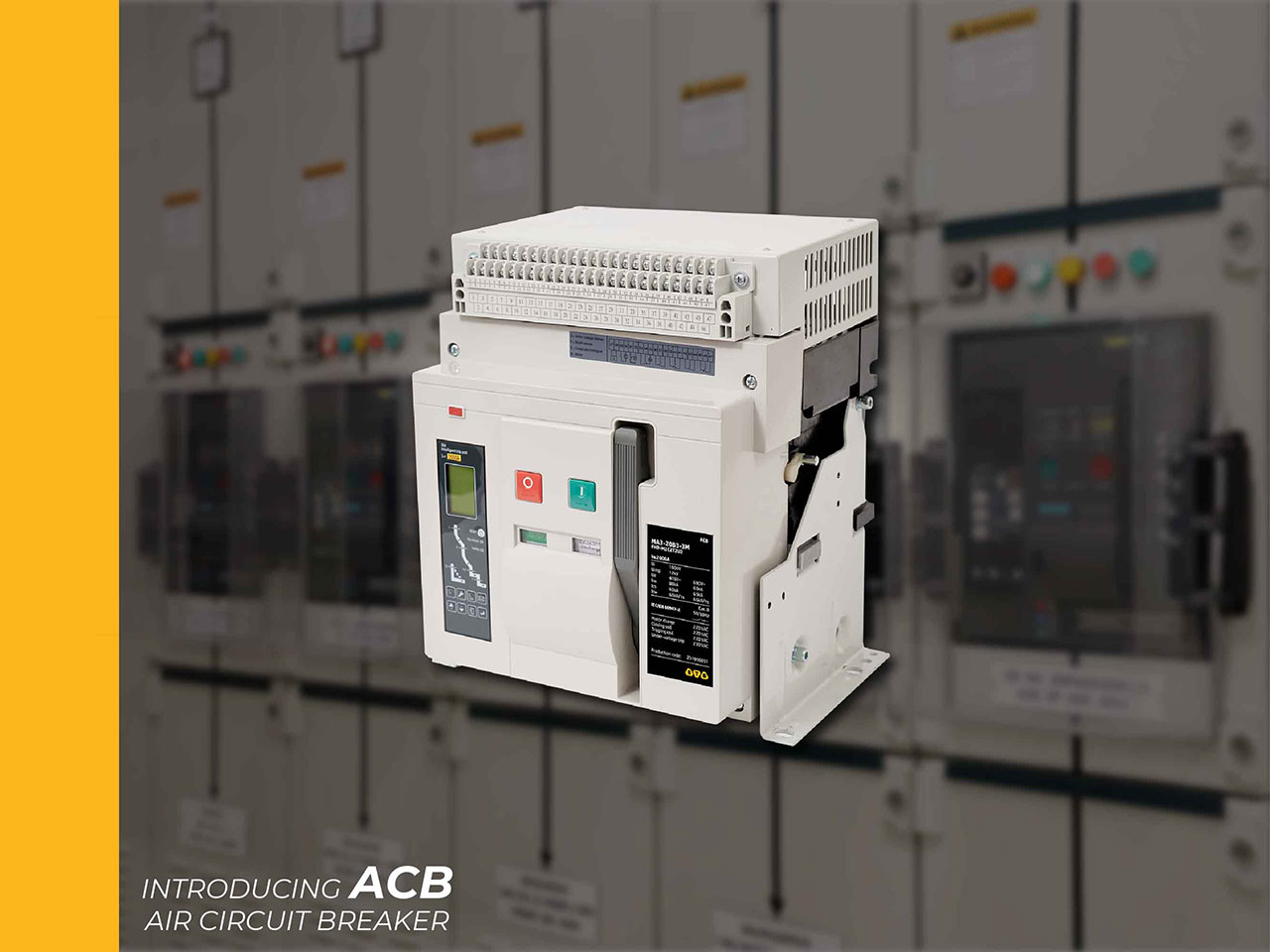
In modern low-voltage distribution panels, M&E contractors classify ACBs into two primary mechanical configurations based on installation and maintenance requirements:
The primary functions of an An Air Circuit Breaker are switching electrical circuits and protecting the system and equipment from overloads and short circuits. With high technical specifications, ACBs serve as main circuit breakers for load centers or outdoor feeders. This is a critical component ensuring the safety of power systems in industrial plants, large construction sites and regional substations.

While the ACB itself is designed for internal panel mounting (typically IP20 rated), it is heavily deployed inside weatherproof outdoor package substations and kiosk transformers, ensuring reliable power distribution in harsh external environments without compromising performance.
ACBs consist of two main components: external and internal structures.

Other external parts include:
Unlike smaller modular breakers, the immense main contacts of an An Air Circuit Breaker are not operated by simple direct manual force. Instead, they rely on a heavy-duty charging spring mechanism to store kinetic energy.
To prepare the breaker for closing, the internal spring must be charged (tensioned) either manually using a front-mounted cranking handle or automatically via a motorized charging unit. Once the spring reaches maximum tension, a built-in interlock prevents overcharging. When the 'Close' button is pressed, the spring's energy is released instantly, forcefully slamming the main contacts shut at ultra-high speeds with a loud, distinct mechanical 'bang'. This extreme speed minimizes arcing during contact engagement, preserving the copper contacts. This same stored spring energy is also used to forcefully drive the contacts apart when a trip command is issued.

The core task of an Air Circuit Breaker during a fault is to safely interrupt the circuit and prevent arc re-ignition after current zero-crossing. ACBs differ from other high-capacity switchgear because their contacts operate in free atmospheric air.
A typical ACB includes two pairs of contacts to manage this process safely:
When the breaker trips due to an overload or short circuit, the sequence is as follows:
Inside the arc chute, the arc is physically stretched, cooled and divided into smaller segments by metal plates. This process rapidly increases the arc voltage until it exceeds the system voltage, leading to complete arc extinction at current zero.

ACBs are exclusively deployed in low-voltage networks requiring ultra-high current capacities and superior fault selectivity. Their primary applications include:
BTB Electric's ACBs comply with IEC/EN 60947-2, offering high flexibility with rated currents from 630A to 6300A and high reliability at impulse withstand voltage (Uimp) up to 12kV. The breaking capacity reaches an impressive 135kA. BTB Electric provides three frame sizes: 2000A, 4000A and 6300A.

ACB accessories include:
BTB Electric offers comprehensive information to help users identify, differentiate and select the right ACB for their application, improving overall electrical system safety.
Ready to specify high-performance, KEMA-KEUR certified ACBs for your next Main Switchboard (MSB) project?
While high-capacity fuses are cheaper and maintenance-free, they are one-time-use devices that cause unacceptable downtime when they blow. ACBs offer superior operational flexibility: you can precisely dial in trip settings (overload, short circuit, ground fault), remotely monitor and operate them via SCADA systems and instantly reset them once a fault is cleared without needing replacement parts.
Yes. An ACB is a highly sophisticated electro-mechanical device. To ensure a lifespan of several decades, ACBs require periodic maintenance. M&E engineers must routinely inspect the arc chutes, clean the heavy-duty copper contacts and lubricate the charging spring mechanism to ensure the breaker operates at its required ultra-high speed during a fault.
No. ACBs are massive, heavy-duty switchgear designed exclusively for low-voltage industrial and large commercial Main Switchboards (MSBs). They handle extreme currents ranging from 630A to 6300A. For residential consumer units, space-saving devices like MCBs or RCBOs are the correct and code-compliant choice.
For critical facilities where power continuity is non-negotiable such as data centers, hospitals and continuous manufacturing plants, a Draw-out ACB is the industry standard. It allows engineers to crank the breaker out to the "Test" or "Disconnected" position for safe maintenance without isolating the entire main busbar. Fixed ACBs are more cost-effective and compact but require a complete panel shutdown to service.