26-11-2026


A Miniature Circuit Breaker (MCB) is a fundamental safety device in modern electrical distribution, completely replacing traditional fuses in households and commercial buildings. Designed to automatically interrupt circuits during overloads or short circuits, MCBs provide resettable, reliable protection. For electrical contractors, selecting the right DIN-rail mounted MCB compliant with IEC 60898-1 is crucial for both project approval and long-term safety. In this guide, BTB Electric breaks down everything you need to know about MCB structures, trip curves and applications.

While traditional fuses blow and require replacement after a fault, MCBs offer a highly convenient, reusable solution. Compact in size, they are integrated into both single-phase and three-phase low-voltage electrical systems.
Beyond their resettable nature, MCBs offer rapid fault identification and effective power distribution. When voltage or current exceeds safe operational thresholds, the MCB’s internal mechanisms instantly disconnect the circuit. This ensures the system runs stably while minimizing energy loss, preventing wire overheating, and eliminating fire hazards that could endanger human safety or damage costly appliances.
A Miniature Circuit Breaker consists of four main internal components:
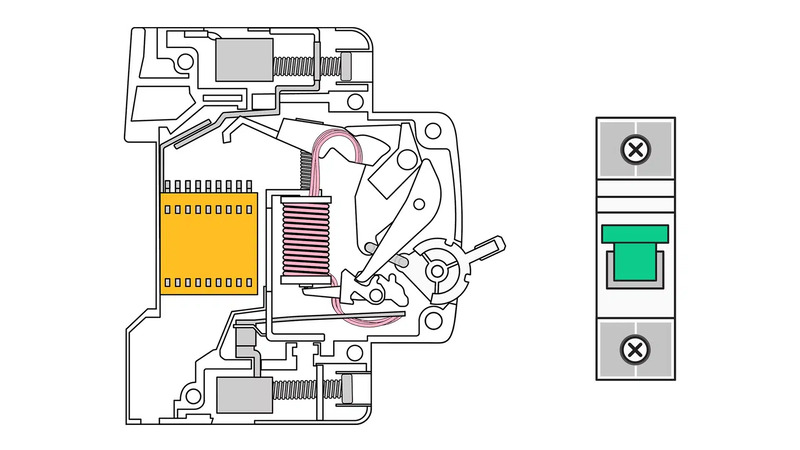
MCBs operate similarly to other breakers with overload and short circuit protection. When the current exceeds the rated threshold, the bimetal strip heats up and bends, triggering a spring-loaded mechanism that opens the contacts and disconnects the circuit. To restore power, the MCB must be manually reset. This mechanism protects the electrical system from overcurrent and overload conditions.
Key indicators for MCB performance include:
MCBs can be classified by:
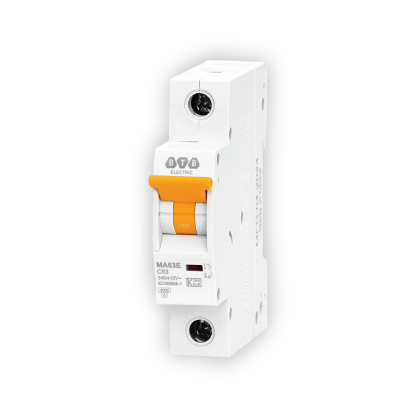 |
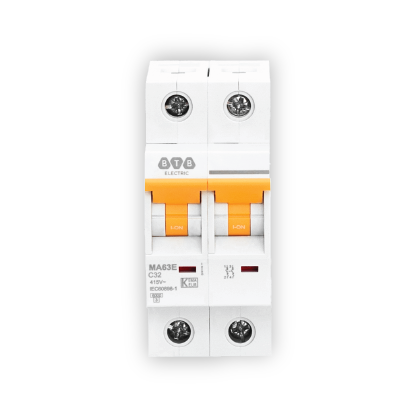 |
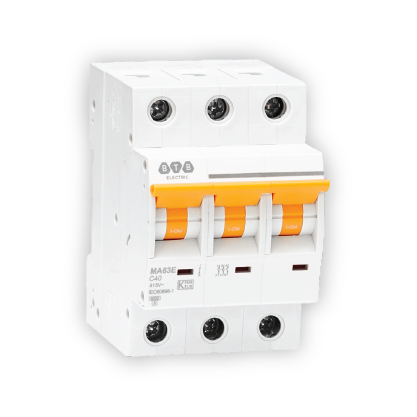 |
In most households, a 63A MCB is used as the main breaker. Higher current MCBs are suitable for commercial uses such as restaurants, spas, or small supermarkets.
MCBs are essential in single-phase residential, commercial, and sometimes even three-phase industrial electrical systems. You’ll commonly find them in electrical panels of homes, apartments, offices, and hotels. They can also be used as dedicated breakers for high-power appliances such as air conditioners, induction cookers, or water heaters.

A Miniature Circuit Breaker monitors voltage and current on a circuit. In the event of an overload or short circuit, it trips to prevent equipment damage or fire hazards. Key advantages of MCBs include compatibility with single-phase systems and low short-circuit breaking capacities (typically 4.5kA–10kA), making them ideal for small devices. Their compact size also allows for flexible installation beyond the central control panel.
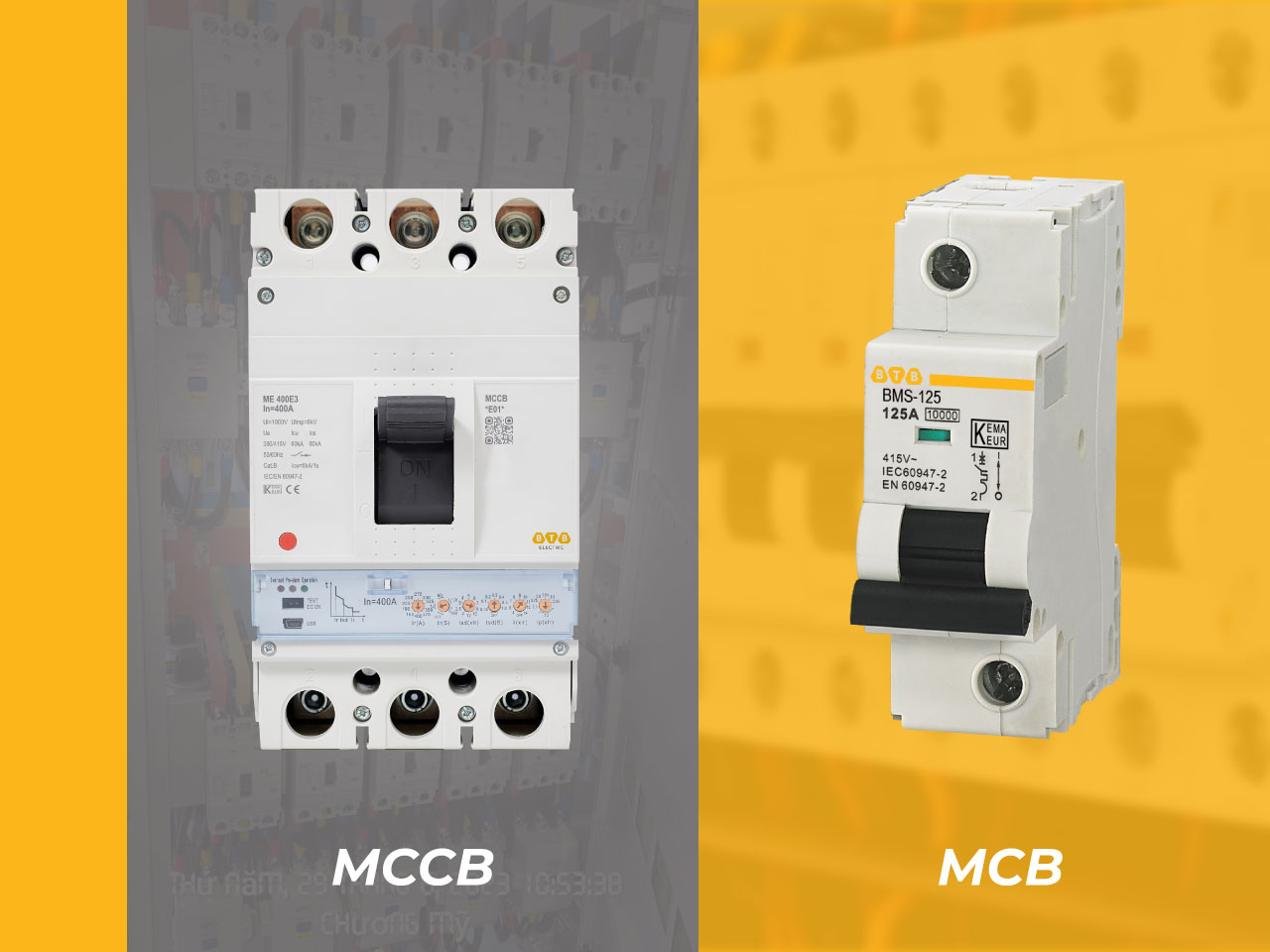
Both MCB (Miniature Circuit Breaker) and MCCB (Molded Case Circuit Breaker) are widely used circuit protection devices. However, they differ in several ways:
| Criteria | Miniature Circuit Breaker | Molded Case Circuit Breaker |
| Mounting style | DIN-rail mounted | Panel / Backplate mounted |
| Rated current (In) | Up to 125A | Up to 1600A+ |
| Breaking capacity (Icu) | Up to 10kA | Up to 100kA+ |
| Trip unit type | Fixed (Thermal-Magnetic) | Fixed or Adjustable (Electronic/Microprocessor) |
| Poles | 1P, 1PN, 2P, 3P, 3PN, 4P | 2P, 3P, 4P |
| Control | Manual only | Remote control available |
| Application | DB boxes, consumer units, residential, light commercial | Main switchboards, industrial motor protection |
If you're dealing with residential systems, an MCB is typically the right choice.

When sourcing MCBs for projects in Southeast Asia, standard compliance is the most critical factor. BTB Electric MCBs are rigorously tested against IEC 60898-1 (for residential and commercial) and IEC 60947-2 (for industrial applications).
Our MCBs strictly align with Singapore Standards (SS) and Malaysian Standards (MS IEC), meaning they fully meet the safety requirements set by the EMA and Suruhanjaya Tenaga (ST). Furthermore, our products proudly carry international certifications from KEMA-KEUR, Dekra and Intertek, guaranteeing top-tier dielectric strength and thermal resistance.
Looking for highly reliable, IEC-certified MCBs for your next M&E project?
[Explore BTB Electric's Full Range of Miniature Circuit Breakers]
Question 1: Does an MCB offer electric shock protection?
Answer: No. MCBs protect against overload and short circuits only. For shock protection, use an RCBO (Residual Current Circuit Breaker with Overload Protection).
Question 2: Where should MCBs be installed in a house?
Answer: Based on load current and usage needs, MCBs are usually installed in distribution panels. For currents under 40A, install them at the sub-panel level. For higher ratings (e.g., 63A), use them as the main breaker at the service panel.
Question 3: Can 2P MCB be connected to a neutral wire?
Answer: Yes. MCB 2P can be wired with either two live wires or one live and one neutral wire.
Question 4: When should I use a 3P or 4P MCB?
Answer: Use 3P and 4P MCBs in three-phase 380V circuits with moderate loads, such as in workshops, pump stations, or small manufacturing units. For higher currents, choose MCCBs, which are more suitable for industrial applications.